
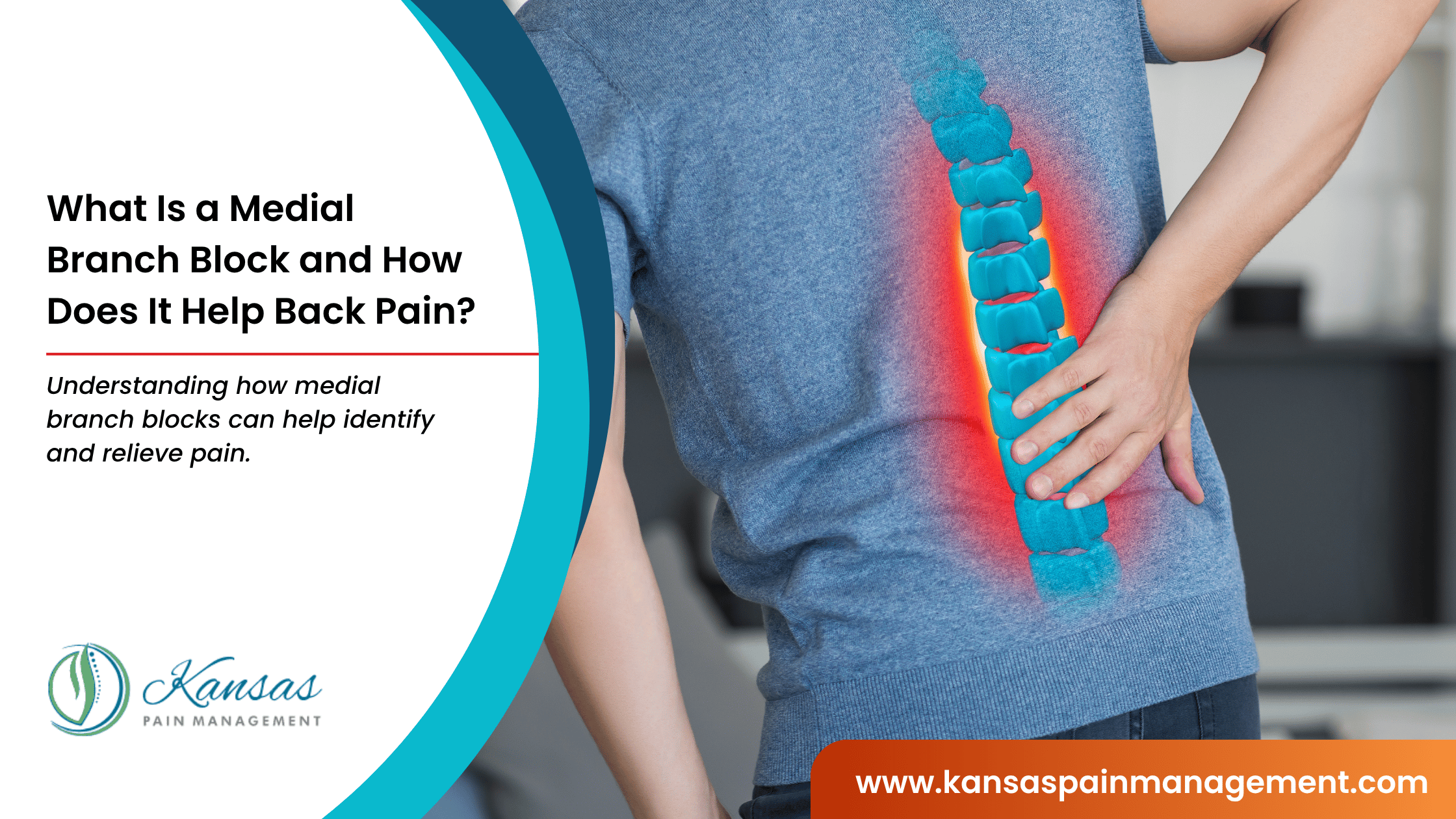
What Is a Medial Branch Block?
If you have persistent lower back or neck pain that hasn’t improved with conservative treatments, your physician may recommend a medial branch block (MBB) to determine whether the small joints in your spine are contributing to your pain.
A medial branch block is a minimally invasive procedure that involves injecting a small amount of local anesthetic near the medial branch nerves that carry pain signals from the facet joints of the spine.
In addition to potentially providing temporary pain relief, a medial branch block can serve an important diagnostic purpose.
If blocking these nerves significantly reduces your usual pain for the expected period of time, it can provide evidence that the facet joints may be an important source of your symptoms.
What Are Facet Joints?
Facet joints are small joints located at the back of the spine. They help connect the vertebrae and provide stability while allowing the spine to bend and rotate.
Like other joints in the body, facet joints can develop arthritis and degenerative changes over time.
When a facet joint becomes painful, you may experience:
- Aching or localized back pain
- Neck pain
- Pain that becomes worse with certain movements
- Stiffness
- Pain when extending or rotating the spine
- Discomfort that may spread into nearby areas
Facet joint pain is only one potential cause of back or neck pain, which is why an appropriate evaluation is important before considering a medial branch block.
How Does a Medial Branch Block Work?
The medial branch nerves are small nerves that transmit pain signals from the facet joints to the spinal cord and brain.
During a medial branch block, medication is placed near these nerves to temporarily interrupt pain signals.
If the facet joint is contributing significantly to your pain, blocking the corresponding medial branch nerve may temporarily reduce your symptoms.
This can help your physician determine whether the facet joint is likely to be a significant source of your pain.
Importantly, a medial branch block does not permanently eliminate the nerve or repair an arthritic facet joint. Its role is often diagnostic, although some patients may experience temporary therapeutic relief.
Why Would a Doctor Recommend a Medial Branch Block?
A medial branch block may be considered when your physician suspects that facet joint pain is contributing to your symptoms.
Your physician may consider several factors, including:
- Your symptoms
- Physical examination
- Medical history
- Response to previous treatments
- Imaging studies when appropriate
Imaging alone does not always determine whether a facet joint is responsible for pain. Some people have degenerative changes on imaging without experiencing pain from those joints.
A medial branch block can therefore provide additional information when evaluating suspected facet-mediated pain.
What Happens During a Medial Branch Block?
A medial branch block is generally performed as an outpatient procedure.
1. Preparation
Before the procedure, your physician will review your medical history, medications and symptoms.
Tell your healthcare team about blood-thinning medications, allergies, infections and other medical conditions.
2. Positioning
For a lumbar medial branch block, you will typically lie face down.
The skin over the treatment area is cleaned and prepared.
3. Local Anesthetic
A local anesthetic is used to numb the skin and tissues around the injection site.
4. Imaging Guidance
Your physician typically uses fluoroscopy (X-ray guidance) to help identify the appropriate anatomical landmarks and accurately position the needle.
5. Medication Injection
Once the needle is positioned near the targeted medial branch nerve, a small amount of medication is injected.
The procedure may involve multiple injection sites depending on which facet joints are being evaluated.
6. Recovery
After the procedure, you will generally be monitored for a short period before leaving.
Your physician may ask you to document how your pain changes during the hours following the block.
This information can be particularly important because the amount and duration of pain relief can help determine whether the targeted facet joints are likely contributing to your symptoms.
Is a Medial Branch Block Painful?
Most patients tolerate the procedure well.
You may feel a brief pinch or pressure when the skin is numbed and the needle is positioned.
Some patients experience temporary soreness after the procedure.
Your healthcare team can explain what you may feel during and after the injection and can answer questions about managing temporary discomfort.
How Long Does a Medial Branch Block Last?
The duration of pain relief can vary.
Because the medication used for a medial branch block is generally intended to temporarily block pain signals, the relief may last for a relatively short period.
However, the duration and degree of relief are important parts of the diagnostic process.
Your physician may ask you to record your pain level and activities following the procedure.
For example, if your usual pain is significantly reduced during the expected period of anesthetic effect and then returns, this information may support the conclusion that the targeted facet joints are contributing to your symptoms.
Is a Medial Branch Block a Permanent Treatment?
Usually, a medial branch block is not considered a permanent solution for facet joint pain.
Its primary purpose is often to help determine whether pain is coming from the facet joints.
If a patient experiences significant temporary relief after an appropriately performed medial branch block, the physician may discuss additional treatment options.
One potential treatment is radiofrequency ablation (RFA).
Medial Branch Block vs. Radiofrequency Ablation
Although medial branch blocks and radiofrequency ablation target related nerves, they serve different purposes.
Medial Branch Block
A medial branch block uses medication to temporarily block pain signals from targeted medial branch nerves.
It can help determine whether facet joints are contributing to a patient’s pain.
Radiofrequency Ablation
Radiofrequency ablation uses controlled radiofrequency energy to disrupt the ability of targeted nerves to transmit pain signals.
For appropriately selected patients with confirmed facet-mediated pain, RFA may provide longer-lasting relief than a diagnostic nerve block.
A medial branch block may therefore be part of the evaluation process before considering radiofrequency ablation.
Your physician will determine whether RFA is appropriate based on your symptoms, response to diagnostic blocks and overall condition.
What Can You Expect After a Medial Branch Block?
After the procedure, you may be able to return home the same day.
Your physician will provide specific instructions about driving, activity and exercise.
You may experience:
- Temporary soreness at the injection site
- Temporary numbness
- Changes in your usual pain
- Short-term improvement in pain
One of the most important things to do after a diagnostic medial branch block is to pay attention to your pain and activity level.
Your physician may ask you to perform certain normal activities and record how your pain responds.
Do not deliberately overexert yourself simply to test the injection. Follow the instructions provided by your healthcare team.
What If the Medial Branch Block Doesn’t Relieve My Pain?
A lack of significant pain relief does not necessarily mean that your pain isn’t real.
It may indicate that the targeted facet joints are not the primary source of your symptoms, or that another pain generator needs to be considered.
Back pain can come from many different structures, including:
- Intervertebral discs
- Nerves
- Facet joints
- Muscles
- Sacroiliac joints
- Spinal stenosis
- Other conditions affecting the spine
Your physician can use your symptoms, examination findings, imaging and response to treatment to help determine the next step.
Are Medial Branch Blocks Safe?
Medial branch blocks are commonly performed interventional pain procedures, but no medical procedure is completely without risk.
Potential risks may include:
- Temporary soreness
- Bleeding
- Infection
- Allergic reaction
- Temporary numbness or weakness
- Nerve irritation
- Medication-related side effects
Serious complications are uncommon, but your physician should explain the potential risks and benefits before the procedure.
Tell your healthcare provider about medications and medical conditions that may affect your procedure, particularly blood thinners or active infections.
Who Is a Candidate for a Medial Branch Block?
A medial branch block may be considered for patients whose symptoms and clinical evaluation suggest that facet joints may be contributing to their neck or back pain.
It may be particularly useful when:
- Pain has persisted despite conservative treatment
- Symptoms are consistent with possible facet-mediated pain
- Your physician needs additional diagnostic information
- You are being evaluated for possible radiofrequency ablation
However, not everyone with back pain is a candidate for a medial branch block.
A pain management specialist can determine whether the procedure makes sense based on your individual circumstances.
When Should You See a Pain Management Specialist for Back Pain?
Consider discussing your symptoms with a pain management specialist if your back or neck pain:
- Continues despite conservative treatment
- Interferes with work or daily activities
- Repeatedly returns
- Limits your mobility
- Makes sleeping difficult
- Has not been adequately explained
- Has not responded to previous treatments
You should seek prompt medical attention for severe back pain accompanied by significant weakness, loss of bladder or bowel control, numbness around the groin or inner thighs, or other concerning neurological symptoms.
What Is the Goal of a Medial Branch Block?
The goal isn’t simply to provide temporary pain relief.
For many patients, a medial branch block is an important diagnostic step.
By temporarily blocking specific medial branch nerves and observing how your usual pain responds, your physician can gather additional information about whether facet joints are contributing to your symptoms.
If the results support a facet-joint source of pain, other treatment options—including radiofrequency ablation in appropriately selected patients—may be considered.
Get Help for Persistent Back or Neck Pain
Living with chronic back or neck pain can affect your work, sleep, exercise and everyday activities.
A medial branch block may be an appropriate diagnostic tool for some patients with suspected facet joint pain, but treatment should always be based on an individualized evaluation.
At Kansas Pain Management, our pain specialists evaluate patients with back, neck and spine-related pain and develop treatment plans based on the underlying cause of their symptoms.
If persistent back or neck pain is affecting your quality of life, talk with a pain management specialist about your options.
Contact Kansas Pain Management to schedule an evaluation and learn whether interventional pain treatment may be appropriate for you.
Frequently Asked Questions
What is a medial branch block used for?
A medial branch block is commonly used to help determine whether facet joints are contributing to neck or back pain. It temporarily blocks pain signals carried by the medial branch nerves.
How long does a medial branch block last?
Pain relief from a medial branch block is temporary and varies from patient to patient. The duration and degree of relief can also provide useful diagnostic information for your physician.
Is a medial branch block the same as an epidural steroid injection?
No. They target different structures and are used for different suspected sources of pain. A medial branch block targets nerves associated with the facet joints, while an epidural steroid injection places medication near spinal nerves in the epidural space.
Can a medial branch block cure back pain?
A medial branch block generally isn’t considered a cure for the underlying cause of back pain. It is often used as a diagnostic procedure and may provide temporary pain relief.
What happens if a medial branch block works?
If you experience significant relief of your typical pain following the block, your physician may consider whether the facet joints are contributing to your symptoms. In appropriately selected patients, radiofrequency ablation may be discussed as a longer-lasting treatment option.
How soon can I return to normal activities after a medial branch block?
Recovery varies depending on the individual and the procedure performed. Many patients return home the same day, but you should follow your physician’s specific instructions regarding driving, exercise and other activities.
Does a medial branch block hurt?
You may experience a brief pinch, pressure or discomfort during the injection. Local anesthetic is generally used to numb the treatment area. Temporary soreness afterward is also possible.
Can a medial branch block be performed for neck pain?
Yes. Medial branch blocks can be used to evaluate suspected facet-mediated pain in both the cervical (neck) and lumbar (lower back) regions of the spine.
Medical Disclaimer: This article is intended for educational purposes only and does not replace professional medical advice, diagnosis or treatment. A medial branch block may not be appropriate for everyone. Talk with a qualified healthcare professional about your individual symptoms and treatment options.