
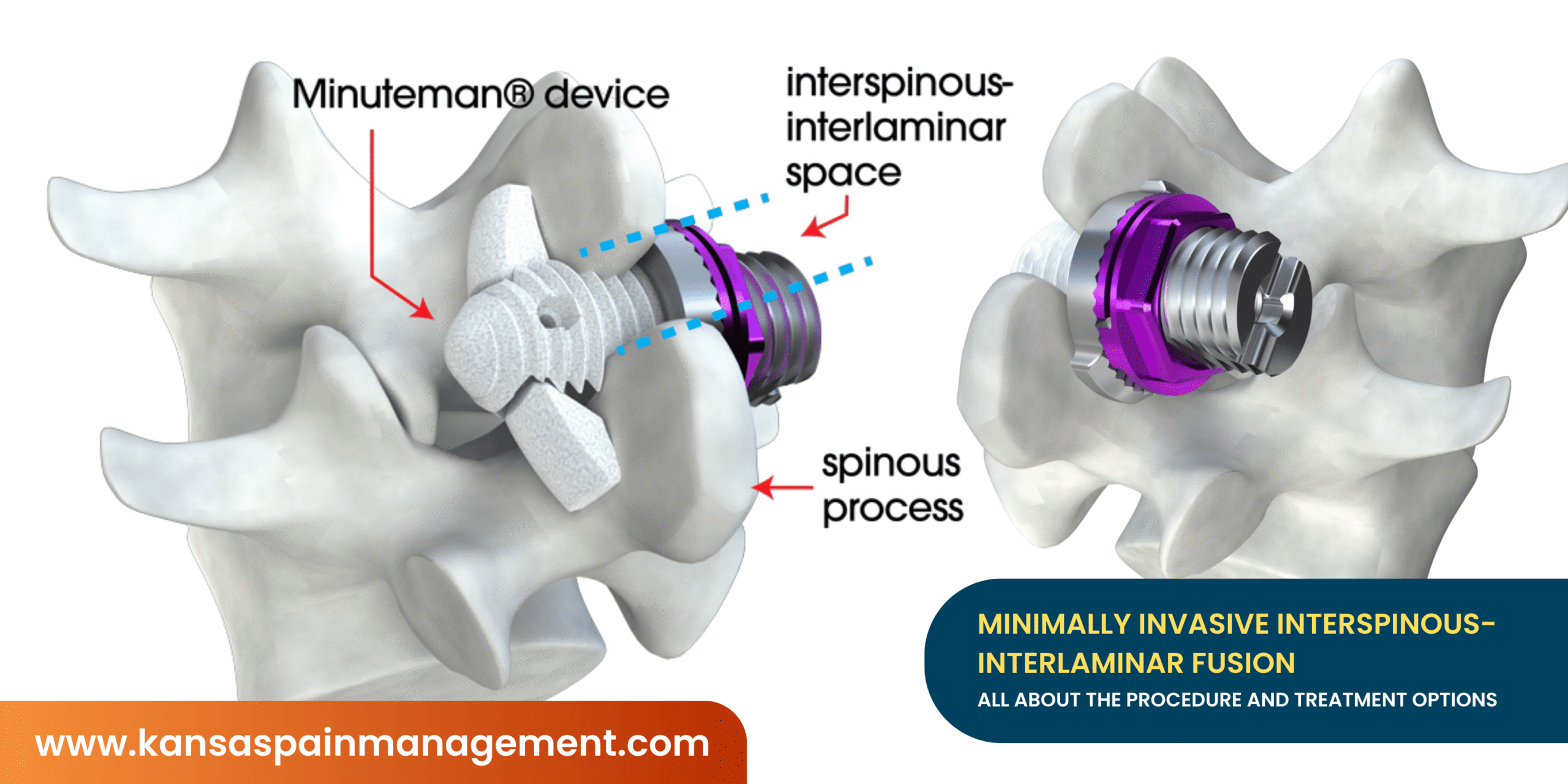
Minimally Invasive Interspinous-Interlaminar Fusion
Minimally invasive interspinous interlaminar fusion is a spine stabilization procedure designed to treat chronic low back pain caused by spinal instability or degeneration.
This technique involves placing a small implant between the bones of the spine (spinous processes) to limit painful movement, stabilize the segment, and reduce pressure on nearby nerves—without the need for traditional open surgery.
Compared to conventional spinal fusion, this approach is less invasive, preserves surrounding tissue, and typically allows for faster recovery.

What Conditions Does This Treatment Help?
- Chronic low back pain
- Spinal stenosis
- Degenerative disc disease
- Facet joint syndrome
- Mild spinal instability
How Does Interspinous Interlaminar Fusion Work?
- A small implant is placed between the spinous processes
- The device limits extension (backward bending) of the spine
- This reduces pressure on nerves and joints
- Over time, the segment stabilizes, reducing pain
What to Expect During the Procedure
Before the Procedure
- Imaging studies such as MRI or CT scan
- Evaluation of prior treatments and symptoms
During the Procedure
- Performed under local anesthesia with sedation or general anesthesia
- A small incision is made in the lower back
- The implant is placed between the vertebrae using imaging guidance
- Procedure typically takes 1–2 hours
After the Procedure
- Most patients go home the same day or next day
- Mild soreness at the incision site
- Gradual return to normal activities
Benefits of Interspinous Interlaminar Fusion
✔ Minimally invasive alternative to traditional fusion surgery
✔ Stabilizes the spine while preserving motion
✔ Reduces pressure on nerves
✔ Shorter recovery time compared to open surgery
✔ May improve walking tolerance and daily function
Many patients experience meaningful pain relief and improved mobility after recovery.
Who Is a Good Candidate?
You may be a candidate if you:
- Have chronic low back pain lasting several months or longer
- Have spinal stenosis or degenerative changes
- Experience pain that worsens with standing or walking
- Have not improved with conservative treatments
- Want to avoid major spine surgery
A detailed evaluation is required to determine if this procedure is appropriate.
Risks & Side Effects
- Infection or bleeding
- Implant-related issues
- Nerve irritation
- Continued or recurrent pain
When Is This Treatment Recommended?
- Conservative treatments have failed
- Pain is related to spinal instability or stenosis
- Symptoms significantly impact mobility and daily life
- Patients want a less invasive alternative to traditional fusion surgery
Recovery & Results
- Initial recovery typically takes a few weeks
- Gradual return to normal activities
- Physical therapy may be recommended
- Long-term improvement in stability and pain levels
FAQs
Treatment Offered By Kansas Pain Management
Kansas Pain Management offers a comprehensive pain treatment plan that is tailored to each patient’s specific needs. The first step is a thorough evaluation, which includes a medical history, physical examination, and diagnostic testing, if necessary.
Treatment options may include medications, physical therapy, injections, or surgery, depending on the underlying cause of the pain.
Kansas Pain Management also offers a range of minimally invasive procedures to help alleviate pain and restore function. With board-certified and fellowship-trained physicians, Kansas Pain Management is committed to providing the highest quality care for patients suffering from pain. You can book an appointment with us at Overland Park, Lawrence, Leavenworth/Lansing, Roeland Park, etc. We also serve nearby locations like Ottawa, Kansas, Topeka, Belton, Manhattan, Lee’s Summit, Johnson County & Kansas areas.
Book an appointment here to learn more or call us at 913-339-9437 to schedule now.
Some Of The Other Surgical Procedures We Provide:
FAQs
Patients with spinal stenosis who have failed conservative treatments and medications, and who experience increased back pain when straightening the back.
Lumbar spinal instability, spinal stenosis at a single level, spondylolisthesis, degenerative disc disease, lumbar fusion after prior spinal surgery, and pseudoarthrosis 12 months from prior spinal surgery.
By fusing vertebrae together and supporting spinal segments with the interspinous-interlaminar fusion device.
Yes, it aims to reduce pain, stabilize the spine, and restore function for patients with spinal conditions.
Insurance Providers
Insurance we provide


Google Reviews
 Posted on Google
 David Wilson
Trustindex verifies that the original source of the review is Google.
Really excellent patient care. Nearly painless s3-s4 injection with good results. I highly recommend Dr. Bell and her staff.Posted on Google Thomasin Kuhn-WichtendahlNicole Walton, NP, and her staff are absolutely wonderful to work with. They are always upbeat, supportive, and truly helpful, which makes managing my medical care so much easier. Together, we’ve been able to keep my chronic conditions from becoming overly painful, and I always feel heard and cared for. I would highly recommend this facility and the entire staff. My experience here has been far better than any of my past attempts with other offices. It’s a relief to finally have a team that makes me feel confident and comfortable in my ongoing care. I wanted to add an update of my most recent visit to this facility seeing a different provider: 6/25/26 I recently had an epidural steroid injection at Kansas Pain Management, and while no one looks forward to procedures like this, the team made the experience as comfortable as possible. From check-in through recovery, everything was organized and efficient. I was brought back for vitals and preparation, then escorted to the procedure room where Dr. Gupta and his staff explained what was happening and kept me comfortable throughout the process. The atmosphere was surprisingly relaxed—even when I joked that my backside was getting cold during the prep, everyone shared a laugh, which helped ease the tension. The injection itself was understandably painful at one point, but Dr. Gupta was clearly targeting the area that needed treatment. The staff responded quickly, kept me informed, and within a couple of minutes I was on my way to recovery. I spent about an hour at the facility from arrival to departure, which I thought was very reasonable. The center was clean, well organized, and I appreciated having an easily accessible restroom near the waiting area. The paperwork process was quick, and it was nice to see familiar staff members who remembered me and genuinely cared about how I was doing. Living with chronic pain can be exhausting, so it means a lot to be treated by people who acknowledge what you're going through, respect your time, and do everything they can to make a difficult procedure a little easier. Thank you to Dr. Gupta and the entire team for your professionalism, kindness, and compassionate care.Posted on Google
 Janell ThomeHad RFA Lower lumbar w/90-95% great result! Would recommend Dr. Dalal. But, if you want touchy/feely pampering, forget it! Dr. Dalal is all business and knows her craft, and gets the job done! Very professional office!

Contact Us
Let's Ge In Touch
Google Reviews
Posted on GoogleDavid WilsonReally excellent patient care. Nearly painless s3-s4 injection with good results. I highly recommend Dr. Bell and her staff.Posted on GoogleThomasin Kuhn-WichtendahlNicole Walton, NP, and her staff are absolutely wonderful to work with. They are always upbeat, supportive, and truly helpful, which makes managing my medical care so much easier. Together, we’ve been able to keep my chronic conditions from becoming overly painful, and I always feel heard and cared for. I would highly recommend this facility and the entire staff. My experience here has been far better than any of my past attempts with other offices. It’s a relief to finally have a team that makes me feel confident and comfortable in my ongoing care. I wanted to add an update of my most recent visit to this facility seeing a different provider: 6/25/26 I recently had an epidural steroid injection at Kansas Pain Management, and while no one looks forward to procedures like this, the team made the experience as comfortable as possible. From check-in through recovery, everything was organized and efficient. I was brought back for vitals and preparation, then escorted to the procedure room where Dr. Gupta and his staff explained what was happening and kept me comfortable throughout the process. The atmosphere was surprisingly relaxed—even when I joked that my backside was getting cold during the prep, everyone shared a laugh, which helped ease the tension. The injection itself was understandably painful at one point, but Dr. Gupta was clearly targeting the area that needed treatment. The staff responded quickly, kept me informed, and within a couple of minutes I was on my way to recovery. I spent about an hour at the facility from arrival to departure, which I thought was very reasonable. The center was clean, well organized, and I appreciated having an easily accessible restroom near the waiting area. The paperwork process was quick, and it was nice to see familiar staff members who remembered me and genuinely cared about how I was doing. Living with chronic pain can be exhausting, so it means a lot to be treated by people who acknowledge what you're going through, respect your time, and do everything they can to make a difficult procedure a little easier. Thank you to Dr. Gupta and the entire team for your professionalism, kindness, and compassionate care.Posted on GoogleJanell ThomeHad RFA Lower lumbar w/90-95% great result! Would recommend Dr. Dalal. But, if you want touchy/feely pampering, forget it! Dr. Dalal is all business and knows her craft, and gets the job done! Very professional office!