
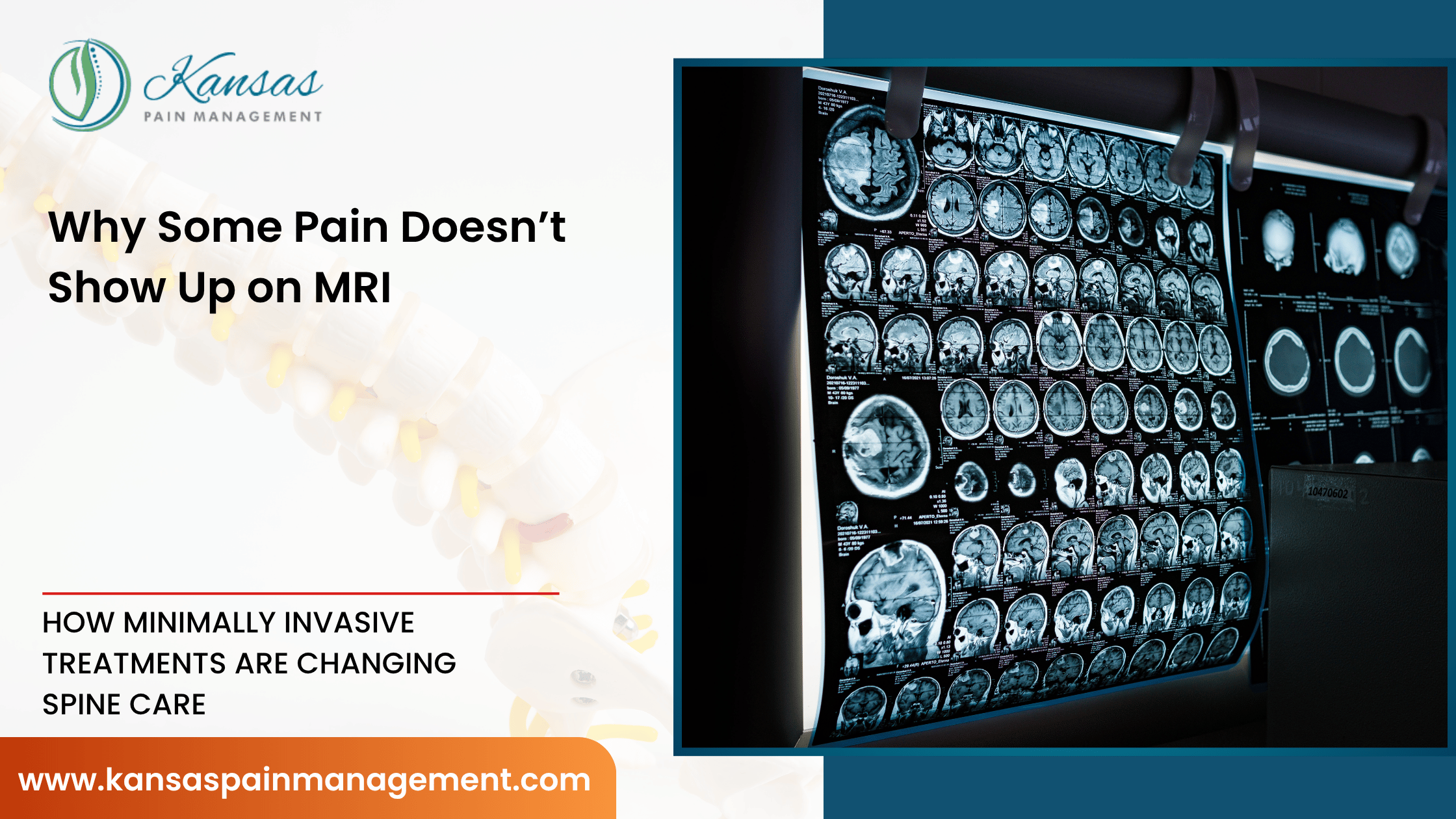
One of the most frustrating experiences for patients is hearing:
“Your MRI looks normal.”
—while still dealing with real, persistent pain.
If this has happened to you, you’re not alone. Many people experience significant discomfort even when imaging tests like MRI or X-rays don’t show a clear problem.
At Kansas Pain Management, we help patients understand that pain is not always visible on imaging—and more importantly, how to accurately diagnose and treat it.
What an MRI Can (and Can’t) Show
An MRI is a powerful diagnostic tool that provides detailed images of:
- Bones
- Discs
- Joints
- Nerves (structural compression)
However, MRIs mainly show structure—not function or sensitivity.
👉 This means they can miss certain causes of pain.
Why Pain May Not Appear on MRI
1. Nerve Sensitivity (Not Compression)
Pain can come from irritated or inflamed nerves, even without visible compression.
- Nerves may be hypersensitive
- Pain signals can be amplified
- No obvious structural abnormality appears
2. Inflammation Without Structural Damage
Inflammation can cause significant pain but may not always show clearly on imaging.
- Soft tissue irritation
- Early-stage joint inflammation
- Chemical irritation of nerves
👉 Pain is real, even if imaging is normal.
3. Muscle and Soft Tissue Issues
MRIs are not always ideal for identifying:
- Muscle tightness
- Trigger points
- Myofascial pain
These can cause persistent discomfort without visible abnormalities.
4. Facet Joint Pain
Facet joints in the spine can be a major source of pain.
- May not show obvious changes on MRI
- Pain is often diagnosed clinically or through injections
5. Sacroiliac (SI) Joint Dysfunction
SI joint issues are frequently missed on imaging.
- Pain in lower back or buttock
- Often requires diagnostic injections for confirmation
6. Early or Subtle Changes
Some conditions are in early stages and not yet visible:
- Mild disc changes
- Early arthritis
- Minor nerve irritation
7. Central Sensitization (Pain Processing Changes)
Over time, the nervous system can become more sensitive.
- Brain amplifies pain signals
- Pain persists without ongoing injury
- No structural issue appears on MRI
👉 This is a neurological process, not a structural one.
Why Imaging Doesn’t Always Match Symptoms
Studies show that many people have:
- Abnormal MRIs without pain
- Pain without abnormal MRIs
👉 This highlights an important point:
Pain is not always about what you see—it’s about how the body processes it.
How Doctors Diagnose Pain Without MRI Findings
At Kansas Pain Management, diagnosis goes beyond imaging.
1. Detailed Symptom History
Understanding:
- When pain occurs
- What triggers it
- How it behaves
2. Physical Examination
- Movement testing
- Identifying pain patterns
- Checking nerve function
3. Diagnostic Injections
👉 One of the most effective tools
- Targets a specific area
- If pain improves → confirms the source
Treatment Options When MRI Is Normal
Even if imaging is normal, effective treatments are available.
Targeted Injections
- Epidural steroid injections
- Facet joint injections
- SI joint injections
Nerve Blocks
- Identify and treat pain sources
- Reduce nerve irritation
Radiofrequency Ablation (RFA)
- Long-term relief by interrupting pain signals
Physical Therapy
- Improves movement and strength
- Addresses muscle-related pain
Nervous System-Focused Care
- Reduces sensitivity
- Helps “reset” pain pathways
When to See a Pain Specialist
You should consider evaluation if:
- Pain persists despite a “normal” MRI
- Symptoms are worsening
- Pain affects daily life
- You’ve been told “nothing is wrong,” but still hurt
Your Pain Is Real—Even If Imaging Is Normal
A normal MRI does not mean your pain isn’t real.
It simply means the cause may not be visible on imaging—and requires a more comprehensive, functional approach to diagnosis and treatment.
At Kansas Pain Management, we focus on finding the true source of pain and providing targeted, non-surgical solutions.
Schedule a Consultation
If you’re experiencing ongoing pain despite normal imaging, a detailed evaluation can help uncover the cause and guide effective treatment.